 SportsIconLegends
Michael Jordan Blasts Modern NBA's 'Load Management' Culture in Scathing Critique
When the GOAT speaks, the basketball world listens. And in 2026, Michael Jordan, now a special contributor for NBC Sports, has just dropped a truth bomb that's shaking the very foundations of the modern NBA. Coming from an era defined by grit, nightly battles, and an uncompromising will to win, MJ's perspective on today's game isn't just commentary—it's a stark reminder of a fading competitive ethos. His target? The pervasive culture of "load management" and what he sees as a fundamental disconnect from the basketball he helped build into a global phenomenon.
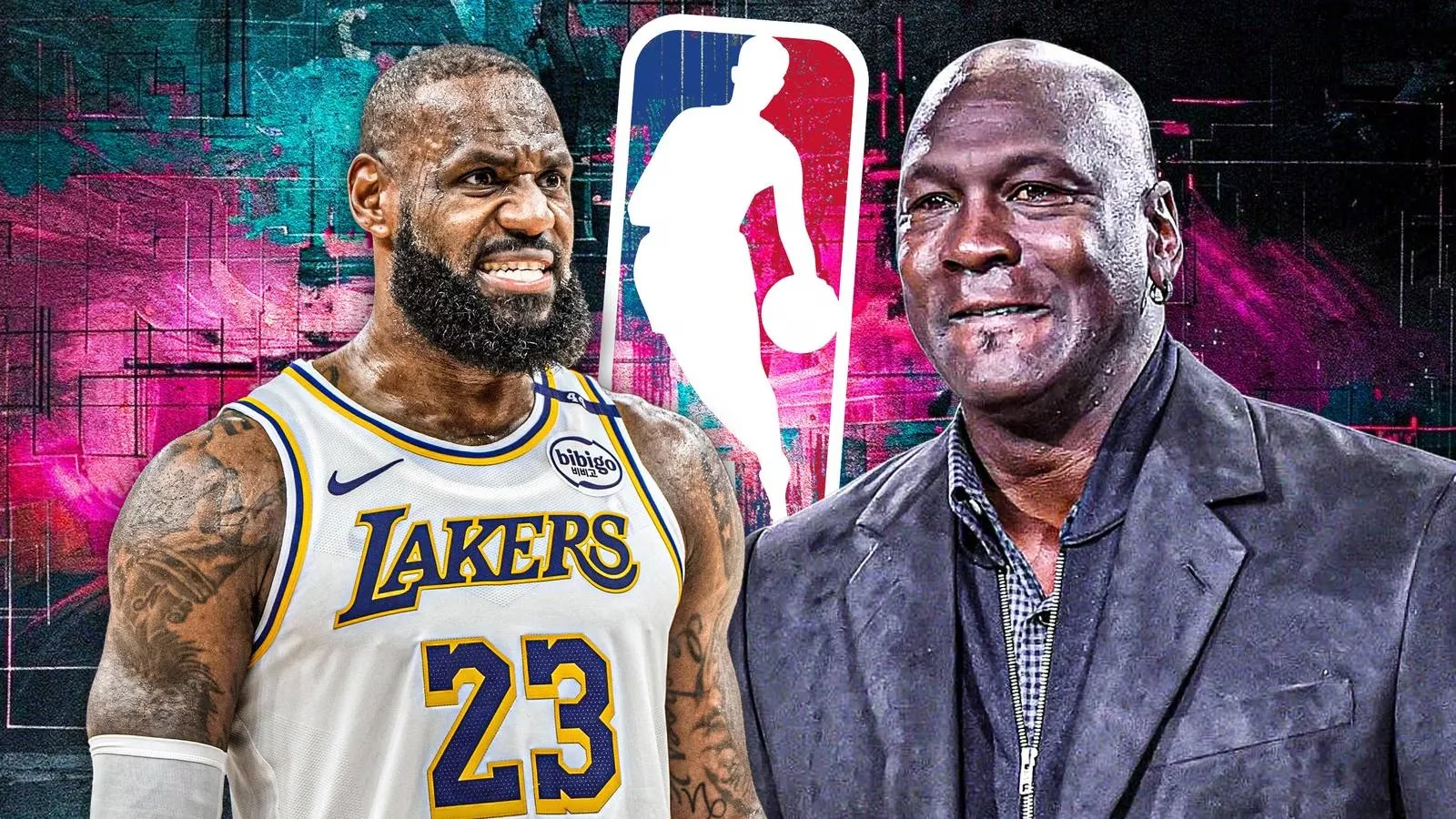
🎤 MJ's New Mic Drop: From the Court to the Broadcast Booth
For the first time since hanging up his sneakers for good in 2003, His Airness has taken an official broadcasting role. In a recent interview with Mike Tirico, Jordan didn't hold back. He publicly called out the practice of players strategically resting during the regular season, labeling it a direct contradiction to the basketball culture he championed in the '80s and '90s. Think about it: would the guy who famously played (and dominated) the "Flu Game" in the NBA Finals ever understand sitting out a Tuesday night game in January to "manage his load"? The answer is a resounding no.
⏳ A Brief History of "Load Management"
So, how did we get here? The concept really took off in the early 2010s, pioneered by the legendary Gregg Popovich and the San Antonio Spurs. They began strategically resting aging veterans like Tim Duncan, Manu Ginobili, and Tony Parker to preserve them for the playoff grind.
Other teams saw the logic—and the success—and followed suit. With advances in sports science and biometric data, franchises began meticulously tracking player fatigue, turning rest into a calculated strategy rather than a reaction to injury. But this created a huge problem: the fans. Imagine paying hundreds of dollars for tickets, bringing your family to see a superstar, only to find out he's "DNP - Rest" despite being perfectly healthy. The backlash was inevitable.
⚖️ The League Fights Back: Rules & Regulations
The NBA had to step in. Here’s a timeline of the league's response to the load management epidemic:
| Year | Policy Action | Key Purpose |
|---|---|---|
| 2017 | Fines for resting healthy players in nationally televised games. | Protect marquee matchups and TV ratings. |
| 2023 | Introduction of the Player Participation Policy (PPP). | A comprehensive set of rules to ensure star availability. |
| 2023-Present | The 65-Game Rule for award eligibility. | Tie major honors (MVP, All-NBA) to minimum games played. |
The PPP is the real heavyweight here. It mandates that:
-
Star players must participate in most games unless legitimately injured.
-
Teams can't rest multiple stars in the same game.
-
Transparent medical reports must justify any absence.
The 65-game rule for awards has been particularly effective. Suddenly, competing for the MVP isn't just about stats; it's about availability. This rule has directly influenced playing time decisions for top-tier talent.
🏀 Jordan's Era vs. The Modern Game: A Culture Clash
Despite these rules, the numbers don't lie. Star players in 2026 still miss significantly more games than their counterparts in the 1990s. Jordan's era operated on a different code:
-
Play through pain was the standard, not the exception.
-
Every regular-season game was a battle for respect and positioning.
-
The long-term physical cost? Often an afterthought. (Just look at the state of many 90s stars' bodies today).
Jordan's critique asks a tough question: Has the pursuit of longevity and optimization come at the cost of the sport's competitive soul? He represents a time when the nightly product was non-negotiable. Can the league ever truly return to that? Probably not. The game has evolved, player care is more sophisticated, and the 82-game season is a brutal marathon.
🔮 The Future: Finding a Balance
Jordan acknowledges that we can't go back in time. However, his comments highlight that "load management" is just one facet of improving the NBA product. He notably pointed to another critical area: officiating. Inconsistent calls and rule enforcement remain a massive point of frustration for players, coaches, and fans alike.
So, what's the path forward? The league is walking a tightrope:
-
Protecting Investments: Teams rightly want to protect their hundred-million-dollar assets.
-
Serving the Fans: The paying customer deserves to see the stars they paid for.
-
Preserving Competition: The integrity of the 82-game season and awards races must be maintained.
The current policies are a step in the right direction, but Jordan's voice adds immense weight to the argument that the balance may still be off. Perhaps the solution isn't just more rules, but a cultural shift—one that re-emphasizes the pride of suiting up every night, a value Michael Jordan embodied like no other.
In the end, MJ's message is clear: greatness isn't just measured in rings and highlights; it's measured in availability, resilience, and an unwavering commitment to the game. As the NBA moves further into the 2020s, finding a way to integrate modern science with that old-school mentality might be its greatest challenge yet. 🏆
Comments